


 LATEST NEWS:
English
20.01.2026
 14:06:00
CONTINUOUS PREDICTIONS OF ECONOMIC COLLAPSE DO NOT CONTRIBUTE TO ECONOMIC DEVELOPMENT OF SRPSKA
BANJA LUKA, JANUARY 20 /SRNA/ - The Republika Srpska meets all of its obligations regularly and on time, has continuous access to the domestic capital market and regularly refinances its maturing liabilities, which represents the best rebuttal of long-standing claims about an alleged bankruptcy that, despite constant announcements, has never occurred, the Ministry of Finance of Srpska told SRNA.
Commenting on claims published in certain media outlets regarding the indebtedness of the Republika Srpska, the Ministry of Finance said it considers it necessary to point out to the public a number of inaccurate, oversimplified and tendentious interpretations that do not reflect the actual state of public finances nor the basic principles of how financial markets function. "First and foremost, it is important to emphasize that analyses periodically presented to the public persistently confuse the concepts of liquidity, solvency and market financing conditions, which leads to incorrect and sensationalist conclusions about the alleged fiscal unsustainability of the Republika Srpska," the Ministry stated. Claims that the level of interest rates directly and exclusively reflects the "unreliability" of a borrower, the Ministry said, represent an oversimplification that does not correspond to the reality of financial markets. "Interest rates depend on a wide range of factors, including the maturity of borrowing, the type of financial instrument, market structure, liquidity, regulatory requirements and the distribution of interest-rate and currency risk. Comparing interest rates paid by citizens with those at which the Republika Srpska borrows is methodologically incorrect. Citizens mostly borrow long-term, with collateral and variable interest rates linked to Euribor, while the Republika Srpska predominantly borrows through short and medium-term instruments with fixed interest rates, under conditions of limited depth of the domestic capital market. In such cases, higher interest rates do not represent a `penalty` but rather a market reflection of maturity, liquidity and the structure of the instrument," the Ministry explained. They emphasized that such practice is not specific to the Republika Srpska, but is common throughout Europe and the region. "The statements of economist Zoran Pavlović, which reduce the borrowing of the Republika Srpska to alleged `pure money trading` and almost automatic bank profits, represent a gross simplification and incorrect interpretation of the basic principles of the financial system. The claim that banks `take money from citizens at 2.5 to three percent and lend it to governments at 5.5 percent,` with the implicit message that this is a safe and risk-free profit, ignores key elements of banking operations: regulatory capital requirements, mandatory reserves, liquidity costs, maturity risk, management costs and provisions for credit risk," the Ministry stressed. They noted that the difference in interest rates is not the same as profit, and that presenting this relationship as simple arithmetic demonstrates a lack of serious financial analysis. "Particularly problematic is the fact that Mr. Pavlović has for many years been publicly presenting claims about an inevitable financial collapse, the inability to service obligations and the unsustainability of public finances in the Republika Srpska. Despite these continuous announcements, the Republika Srpska services all of its obligations regularly and on time, refinances maturing liabilities and maintains access to capital markets. The fact that the repeatedly announced bankruptcy scenarios have not materialized seriously calls into question the analytical foundation of such assessments," the Ministry said. In addition, comparisons with measures introduced by certain countries in extraordinary circumstances, such as Hungary, are made without any context of the institutional, regulatory and fiscal frameworks in which those measures were adopted. "Such selective and populist comparisons do not represent a relevant argument in a serious discussion on public finances, but serve solely to create a negative narrative without grounding in real indicators. Public discourse on borrowing requires responsibility, precision and consistency," the Ministry emphasized. The continuous presentation of dramatic assessments that are not confirmed in practice cannot be considered expert analysis, but rather the repetition of preconceived views that fail the test of reality, the Ministry stated. They added that rhetorical questions about "who will repay the debt" ignore basic principles of public finance. "Public debt is not assessed through the absolute number of inhabitants, but through the debt-to-GDP ratio, fiscal capacity and the dynamics of economic growth. Demographic challenges exist across Europe, but they do not in themselves imply fiscal collapse or an inability to service obligations. Critical analysis of borrowing is legitimate and desirable, but it must be based on facts, economic logic and a comprehensive understanding of context. Selective comparisons, simplified interpretations and continuous predictions of financial collapse do not contribute to objective public information or economic development, but solely to the creation of dissatisfaction among citizens based on falsehoods and half-truths," the Ministry pointed out. They concluded that the Republika Srpska will continue to pursue a responsible public finance management policy, based on real market conditions and the regular fulfillment of all assumed obligations.
English
7 hours ago
GOVERNMENT OF SRPSKA REAPPOINTED
BANJA LUKA, MARCH 17 /SRNA/ - On Tuesday evening, the National Assembly of Republika Srpska voted in a new Government of Republika Srpska headed by P...
7 hours ago
FILM "ISHOD" ABOUT EXODUS OF SARAJEVO SERBS PREMIERS
BANJA LUKA, MARCH 17 /SRNA/ - The documentary film “Ishod” /Outcome/ about the mass exodus of more than 150,000 Sarajevo Serbs forced to leave their h...
11 hours ago
GAGIĆ: ONLY RELIGIOUS CEREMONY ACCEPTABLE IN MODRAN; LAW ON CEMETERIES MUST BE ADOPTED URGENTLY
DERVENTA, MARCH 17 /SRNA/ - A religious ceremony in Modran near Derventa is acceptable to the Veterans’ Organization of Republika Srpska /BORS/, but t...
11 hours ago

CONSTRUCTION OF NEW TREASURY DEPOSITORY WILL BEGIN THIS YEAR WITH GOVERNMENT FUNDS ALLOCATED FOR HILANDAR
BELGRADE, MARCH 17 /SRNA/ - The Hilandar Monastery Endowment will allocate 138.5 million dinars /around 1.18 million Euros/ provided by the Government...
12 hours ago
RESOLUTION CONDEMNING REVIVAL OF IDEOLOGY OF NDH AND DENIAL OF GENOCIDE AGAINST SERBS ADOPTED
BANJA LUKA, MARCH 17 /SRNA/ - The National Assembly of Republika Srpska unanimously adopted a Resolution proposed by the parliamentary majority condem...
13 hours ago
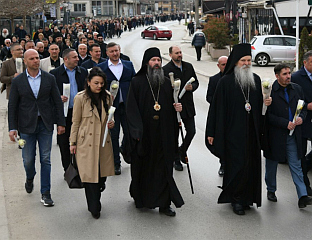
MARCH POGROM ONE OF THE MOST HORRIFIC EVENTS IN MODERN EUROPE
PODGORICA, MARCH 17 /SRNA/ - The March Pogrom is one of the most horrific and most shameful events in modern Europe, which to this day has not receive...