


 LATEST NEWS:
English
26.09.2023
 11:39:00
DIKLIĆ: SOME RESCUED SERBIAN CHILDREN ENDED UP IN THE VATICAN
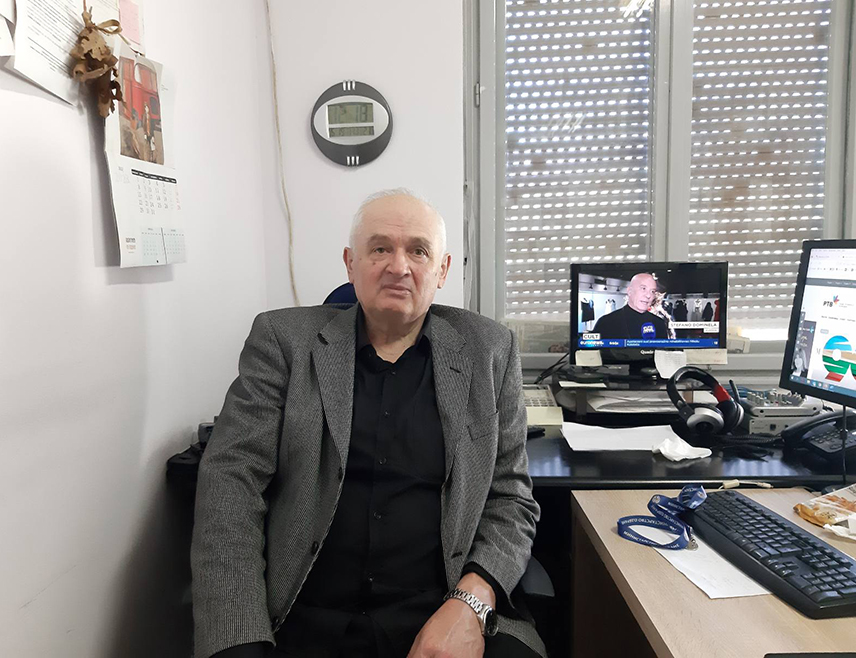
A man in the Vatican archives said that he was not Italian but from Potkozarje. The old monsignor, a Catholic dignitary, told him before his death: "Since you were good to me, I will tell you - You are not so and so, Italian by name and surname, but you are from there because you were distributed all over the world." By Vesna ŠURBAT
BELGRADE, SEPTEMBER 26 /SRNA/ - Historian Momčilo Diklić told SRNA that Serbian children who were rescued from Ustashe concentration camps were sent all over the world and Europe, as well as to the Vatican. Diklić has long followed the situation regarding the Catholicization of Serbs in Croatia. He has said that his late friend Milan Divjak Lički, who researched the Vatican archives by order of the Executive Council of Vojvodina, told him that a man in that archive, who was helping him, told him that he was not Italian, that he was from Potkozarje, but did not know from which village. When asked by Divjak how he found out, that man replied that he was in charge of looking after an old monsignor, a Catholic dignitary, who told him before his death: "Since you were good to me, I will tell you - You are not so and so, Italian by name and surname, but you are from there because you were distributed all over the world." Diklić has said that it is also interesting to note that on January 12, 1944, in Otočac, the Serbian Club of Councilors was founded in the National Anti-Fascist Council of the People's Liberation of Croatia /ZAVNOH/, which made the decision to cancel all conversions to Catholicism, i.e., that all Catholicized Serbs and those Serbian children should return, but that one of the main Croatian communist officials at the time, Vladimir Bakarić, said that the club was "not needed." According to Diklić, data has appeared for children who were at the time of the Independent State of Croatia /NDH/ in the "Institute for the Deaf," where Serbian children who were rescued by Diana Budisavljević from the Ustaše camps were housed, and we are talking about more than 5,000 names, with data on where they were received, where they converted to Catholicism, where they went. "The children ended up not only in Croatian families but also all over the world, in Europe and in the Vatican. Who knows where else? It's a coincidence that this man told Milan Divjak - this is me. He was given an Italian name. He used to come with Divjak, and he visited three times. Divjak drove him around Bosanska Krajina, but they didn't find anything because whole families were erased," said Diklić. Diklić has said that there are many such cases of Serbian children who were in Croatian families, and all over the world. "Where there were two or three children from one family, they tried to scatter them to different sides, so that they lose all connection with themselves," Diklić pointed out. He added that it was known that this happened and that he also knew those who did not hide that they had forcibly converted to Catholicism before the war, but that now few of them are alive. CONVERSION TO CATHOLICISM IN CROATIA IN RECENT TIMES IS OUT OF FEAR Diklić pointed out that he had also been following how conversion to Catholicism has been carried out in Croatia in recent times, and added that many people switched to the "other side" due to fear, and cited an example of how Serbian children were converted to Catholicism. "They decided that religious education should be the third class, and some Serbian or mixed-ethnicity children do not go to religious education. Then there were groups that beat and bullied them. And then at the end, parents write a request, begging that their children be admitted to religious education. Some even wrote twice. And today or tomorrow it will be a fact for someone to say - look, we saved them. Just like /Ustashe Archbishop Alojzije/ Stepinac saved them," said Diklić. "I LIVE TO SEE MEMORIAL CENTER IN DONJA GRADINA" Diklić emphasized as extremely significant the construction of memorial centers in Donja Gradina and Belgrade dedicated to the Serbian victims of Jasenovac. He noted that it should be written on the Donja Gradina Memorial Center "Gradina camp - part of the Jasenovac concentration camp" so that no one from the Croatian side, but also from the BiH level or from the international community, could dispute this because there is already the Jasenovac center in Croatia. "There must always be an inscription reading that it is part of the Jasenovac camp, especially if they dispute it from the other side /from Croatia/, as well as from the level of BiH, who can say - we don't need a new memorial center because there is already the Jasenovac center in Croatia, and Europe will say - what do you want?" Diklic said. Thus, Diklić added, the center in Gradina would be "part of Jasenovac," but it would be managed by people from Republika Srpska and controlled by Serbs, and visitors would get all the information about what happened in Jasenovac. "That center should have already existed, so that tens and hundreds of thousands of people could pass by and see films, materials and documentation. I live to see that memorial center in Donja Gradina," said Diklić, who believes that even during the construction of that memorial center, bones of martyred inmates will be found. Diklić, who was a senior associate at the Institute for European Studies in Belgrade, pointed out that the camp in Gradina was a terrible place, and that he regretted that excavations were stopped after the World War II, especially since corpses were still floating on the Sava until 1955. When Yugoslavia fell apart, it was necessary to organize working actions, and a few thousand volunteers, I would be the first, to dig up all of Gradina, 15 or 20 kilometers. Then we would prove it in the following way - right femur, left femur. Data would certainly not be precise, but it would be convincing to refute these Croatian narratives," said Diklić. He pointed to the revision of history in Croatia, where at the Faculty of Croatian Studies, Vlatka Vukelić, who teaches the history of the NDH, claims that when the inmates go to break through Jasenovac, it is a "group of zombies," and added that they are moving towards the negation of everything that happened. "And that would not have been possible if we had informed the world /about that suffering/ in a timely manner. We experienced the absurdity of someone declaring us a genocidal nation, the nation that suffered the most from genocide in this region, perhaps in the world, considering the number of inhabitants," Diklić pointed out. HIDING DATA ABOUT JASENOVAC Diklić has said that it is known that after the World War II, "Bakarić's system" hid all the data on the number of victims in Jasenovac, that the loading lists and data related to the Gospić concentration camp and its branches disappeared. "It's not the Jadovno concentration camp, it's the Gospić concentration camp, and Jadovno is one of the most terrible camps that was there. That documentation was removed in 1966. The Jasenovac documentation was removed earlier," noted Diklić. For this reason, he considers the construction of a memorial center in Donja Gradina a great step forward, because it would be the most important place where information could be obtained about the suffering of Serbs in Jasenovac, and not only in Jasenovac but also the entire NDH, which was the killing ground of Serbs. "Just as all the loading lists related to Jasenovac were removed, so were the data and documentation of the Austrian humanitarian Diana Budisavljević confiscated. She saved between 11,000 and 12,000 Serbian children from being killed, although the precise number is not known," he said. Diklic. He added that the Croatian side is trying various methods to deny, first of all, that it happened at all, to say that it was an accommodation area, then a "pre-educational" area and the like, as well as that Stepinac was one of the "saviors." "To say that Stepinac was one of the saviors is absurd. He got involved in 1943, when he realized that he had to get involved, only for the children to convert to the Catholic faith. And they were converted," said Diklić. Diklić recalled that in 1974 when he was a student in Rijeka, he watched a show on the Italian television channel RAI Uno, whose recordings had the inscription "Gospić Concentration Camp," and added that the Italians have all films and documentation about what was done with the Serbs, but that the Yugoslav leader Josip Broz Tito and the authorities were not interested in buying them off. "I believe that the Germans also have films about Jasenovac," said Diklić. Momčilo Diklić worked for more than a decade at the Institute for European Studies in Belgrade as a senior scientific associate, until his retirement in 2019. He was born in 1954 in Otočac, Lika, Croatia, where he completed elementary and secondary school, graduated from the Pedagogical Academy in Rijeka, graduated from the Faculty of Philosophy in Zagreb, where he defended his master's thesis "The Position of Serbs in Croatia" as the first Serb in the communist Croatia. In 2003 in Novi Sad, Diklić defended his doctoral dissertation "Serbian Question in Croatia 1941-1950," which is the first doctoral dissertation with such a topic defended in Serbia. He published 15 monographs and dozens of scientific papers, as well as several publicist texts on Serbian-Croatian relations.
English
12 hours ago
SRPSKA STRENGTHENING ITS GEOPOLITICAL POSITION BY TIES WITH U.S., RUSSIA AND CHINA
TREBINJE, JUNE 9 /SRNA/ – Republika Srpska's geopolitical position is undoubtedly favorable today, as it maintains good relations with the new US admi...
12 hours ago
GREIF: TRUTH ABOUT JASENOVAC MUST BE PASSED ON EVERY DAY
PALE, JUNE 9 /SRNA/ - World-renowned Israeli historian and Holocaust expert Gideon Greif has stated today in Pale that he has spent the past 14 years...
14 hours ago
DODIK: REMEMBRANCE OF ČEMERNO IS A DUTY SO THE TRAGEDY OF 1992 IS NEVER REPEATED
BANJA LUKA, JUNE 9 /SRNA/ – President Milorad Dodik stated that there is scarcely a place in Republika Srpska and the Federation of BiH that has not b...
16 hours ago

STEVANOVIĆ: IT IS IMPORTANT THAT SRPSKA OPENS UP TO REGION AND EUROPE
BANJA LUKA, JUNE 9 /SRNA/ - The Minister of Transport and Communications of Republika Srpska Zoran Stevanović stated that it is very important to enco...
16 hours ago
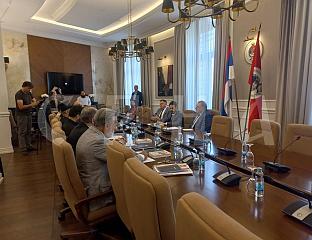
ROMIĆ: INAUGURAL HILANDAR DAYS CELEBRATION IN REPUBLIKA SRPSKA THIS YEAR
BANJA LUKA, JUNE 9 /SRNA/ – Marko Romić, Chairperson of the Republika Srpska Government Commission for Hilandar Monastery, announced that the inaugura...
18 hours ago
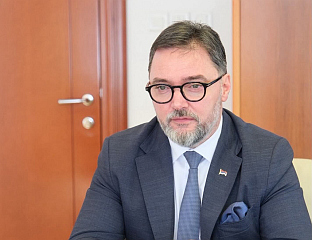
OHR FALSIFIES DAYTON, ATTRIBUTES TO ITSELF STATUS OF "AD HOC INTERNATIONAL INSTITUTION"
SARAJEVO, JUNE 9 /SRNA/ - Deputy Chair of the Council of Ministers Staša Košarac stated that what can be read today on the official website of the OHR...