


 LATEST NEWS:
English
11.07.2026
 14:41:00
DODIK: CRIMES AGAINST SERBIAN PEOPLE CANNOT BE FORGOTTEN OR FORGIVEN
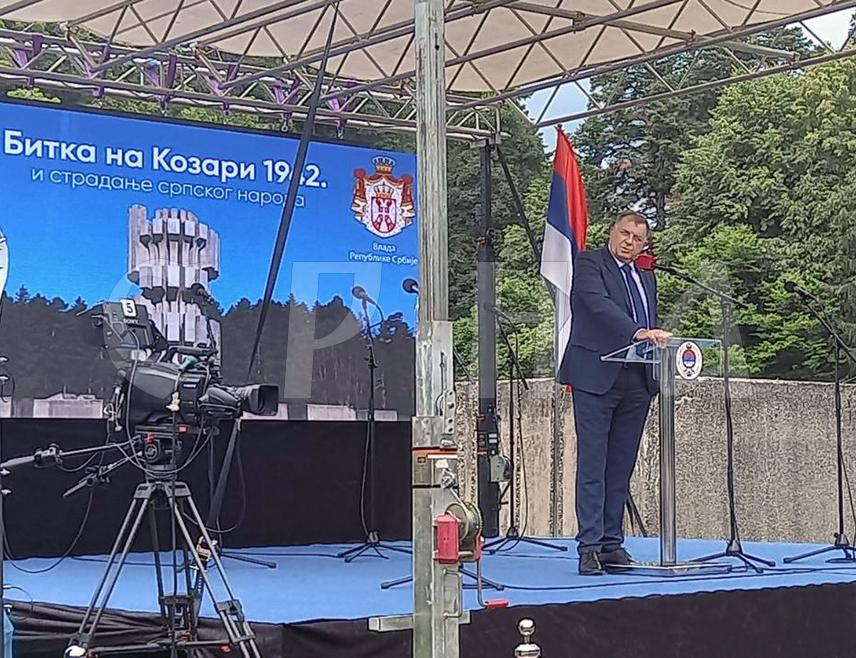
PRIJEDOR, JULY 11 /SRNA/ - President Milorad Dodik stated that the crimes committed against the Serbian people on Kozara, and later in the Ustasha concentration camp of Jasenovac, can never be forgotten or forgiven.
"It has never been allowed for Jasenovac to be classified in the way contemporary history treats it, which represents an injustice toward us," Dodik said at Mrakovica, where the 84th anniversary of the Battle of Kozara was commemorated. He emphasized that they had not gathered at Mrakovica to mark the disappearance of a people, but to commemorate the suffering that forms the foundation of the Serbian people's existence. "Much has been said about Kozara throughout history, yet it has never been fully told. The facts about the suffering are clear. On Kozara, our people were surrounded, and more than 80,000 Serbs were rounded up and taken to Jasenovac, where they were killed, including a great number of children," Dodik said. He recalled that the official policy of the Independent State of Croatia (NDH) was to kill one-third of the Serbs, forcibly convert one-third to another faith, and expel one-third. "They persistently pursued this policy until the very last day of the Second World War, as best illustrated by the fact that Belgrade had long since been liberated while Serbs were still being killed in Jasenovac," Dodik said. He also noted that the Bosniak people today commemorate the suffering in Srebrenica, where, according to data from the Hague Tribunal, 4,150 people were killed, primarily Muslim soldiers. "It is a heinous lie that 8,000 people were killed there, and they are trying to use those alleged false facts to create false qualifications about that event. I do not wish to offend anyone; in peace, we should pay our respects to all victims, but the politicization of that event cannot continue," Dodik said. He pointed out that Republika Srpska today is united and that it had two liberation movements — the Partisan movement and the Yugoslav Army in the Homeland, a position that, he noted, had at one time also been acknowledged by the Americans and the West. Dodik stated that there are no commemorations of Muslim suffering during the Second World War because there was none, given that Muslims were on the side of the Ustasha state. "They were the flowers of the Ustasha movement. They slaughtered Serbs. For fifty years, we were prevented from speaking the truth and from asking why Muslims do not commemorate events from the Second World War," Dodik said. He stated that four Muslim mayors of Sarajevo during the Second World War had sent Serbs to the Jasenovac concentration camp. "Serbs showed naivety by liberating other nations in the First and Second World Wars, only to be killed and expelled from Sarajevo at the end of the last century," Dodik said. In addition to Dodik, those attending the commemoration at Mrakovica included the Speaker of the National Assembly of Republika Srpska, Nenad Stevandić, Prime Minister Savo Minić, ministers in the Government of Republika Srpska, representatives of the Government of Serbia and the Russian Embassy in BiH, members of parliament, as well as representatives of Republika Srpska in the joint institutions of BiH. Also in attendance were Viktor Nuždić, Director of the Republika Srpska Center for the Research of War, War Crimes and the Search for Missing Persons, Chief of the Joint Staff of the Armed Forces of BiH General Gojko Knežević, representatives of the Third Infantry /Republika Srpska/ Regiment, organizations stemming from the Second World War and the Defensive-Patriotic War, as well as representatives of local communities. The Battle of Kozara is a symbol of the suffering and resistance of the Serbian people in the fight against the Nazis and Ustasha forces. During the battle, around 40,000 civilians were killed, while 68,000 were taken to concentration camps, including more than 23,000 children.
English
3 hours ago

EU AGRICULTURE UNDER STRAIN
BRUSSELS, AUGUST 23 /SRNA/ - Farmers across the European Union have warned of sharp declines in crop yields after successive heatwaves swept across Eu...
6 hours ago
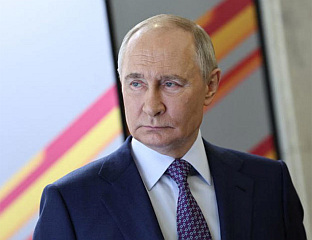
PUTIN: WE WILL NOT TOLERATE GLORIFICATION OF NAZISM IN UKRAINE
PETROPAVLOVSK-KAMCHATSKY, August 23 /SRNA/ - Russian President Vladimir Putin said that the glorification of Nazism in Ukraine is part of the problem...
7 hours ago
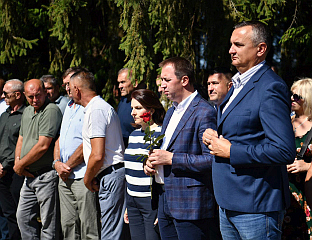
SELAK: WE WILL CONTINUE TO OPPOSE GLORIFICATION OF USTASHA IDEOLOGY
BANJA LUKA, AUGUST 23 /SRNA/ - Republika Srpska Justice Minister Goran Selak attended a memorial service in Trnopolje for innocent Serb victims of an...
8 hours ago
SRPSKA BANKING AGENCY RECEIVED NO PROPOSAL TO RAISE CONSUMER LOAN LIMIT
BANJA LUKA, AUGUST 23 /SRNA/ - The Republika Srpska Banking Agency has not received any letter, proposal or initiative concerning an increase in the c...
8 hours ago
LINTA: ATTACKS ON SERBS SHOW HATRED AND VIOLENCE ARE REWARDED IN CROATIA
BELGRADE, AUGUST 23 /SRNA/ - The latest cowardly attacks by Ustasha hordes on Serbs in Dubrovnik and Pag are among countless confirmations that Croati...
9 hours ago
TEN TIMES MORE SERBS DIE IN SARAJEVO EACH YEAR THAN ARE BORN
BELGRADE, AUGUST 23 /SRNA/ - Ten times more Serbs die each year in Sarajevo than are born there, while no Serb children are born in the formerly predo...