


 LATEST NEWS:
English
08.06.2024
 17:39:00
ASSEMBLY TO BE HELD EVERY TWO YEARS, FEBRUARY 15TH DAY OF STATEHOOD OF SRPSKA AND SERBIA, JANUARY 9TH DAY OF ESTABLISHMENT OF SRPSKA AND PATRON SAINT
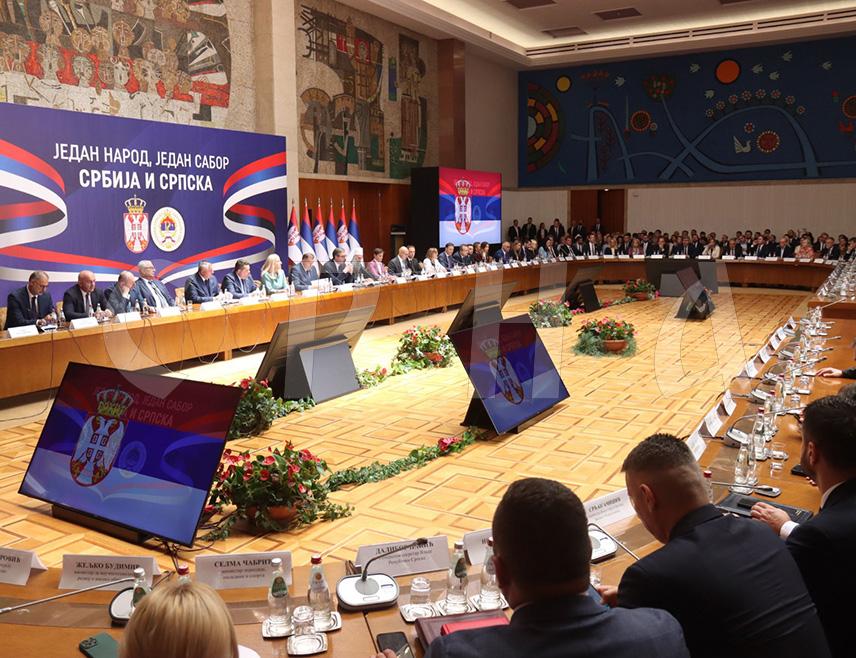
BELGRADE, JUNE 8 /SRNA/ - At the All-Serb Assembly of the Serbian People, the necessity of a Serbian national gathering was pointed out, and it was decided that the Assembly would be held regularly, every two years, at which the most important national issues would be discussed together with the participation of representatives of Republika Srpska and of the Republic of Serbia, as well as other representatives of the Serbian people from the region and the world.
The All-Serb Assembly decided that Sretenje, February 15, the Statehood Day of the Republic of Serbia, would also be the Statehood Day of Republika Srpska and that the date should be celebrated together, unitedly, while Republika Srpska will continue to celebrate January 9 as the Day of Republika Srpska's creation and Patron Saint's Day. The text of the Declaration SRNA transmits in its entirety: Emphasizing the common history of the Serbian people and recalling the centuries-old Serbian statehood in the Balkans, especially remembering important historical events, the All-Serb Assembly of the Serbian People of the Republic of Serbia and Republika Srpska adopts the following: CONCLUSIONS, POSITIONS AND OBJECTIVES 1. The All-Serb Assembly consists of representatives of Serbs elected to legislative and executive authorities, members of academies of sciences and arts, members of the Serbian Orthodox Church Assembly and other representatives of the Serbian people invited by the organizers of the All-Serb Assembly. 2. The All-Serb Assembly constitutes the National Council of the Serbian People, which is in charge of coordinating, monitoring and executing the acts of the All-Serb Assembly, as well as its own acts. 3. The National Council of the Serbian People consists of: the presidents of the Republic of Serbia and Republika Srpska, the speakers of the national assemblies, the presidents of the governments of the Republic of Serbia and Republika Srpska, the Minister of Foreign Affairs of the Republic of Serbia, the presidents of the academies of science and art of the Republic of Serbia and Republika Srpska, the representative of the Senate of Republika Srpska and the president of Matica Srpska. The All-Serb Assembly, by consensus, appoints representatives of the Serbian people from Montenegro, the Federation of Bosnia and Herzegovina, Northern Macedonia, Croatia, Slovenia, representatives of the Serbian people from Europe, Africa, Asia, North and South America, Australia, as well as prominent scientists and artists as members of the National Council of the Serbian People, entrepreneurs, athletes and national workers. 4. The All-Serb Assembly states that the Serb people represent a unique entity. Throughout history, the Serbian people have had several states with different names, and claim the right to inherit their rich tradition. 5. The All-Serb Assembly establishes that the name of the nation is one and that it is impossible to change it. Various imposed prefixes that were added before the noun Serbs are rejected. Members of the Serbian nation have the right to call themselves Serbs, no matter where they currently live. 6. The All-Serbian Assembly notes the necessity of a Serbian national gathering, and decides that it is necessary to hold an All-Serb Assembly regularly, every two years, at which the most important national issues would be considered together with the participation of representatives of the Republic of Serbia and Republika Srpska, as well as other representatives of the Serbian people from region and the world. 7. The All-Serb Assembly expects the full realization of the process of national reconciliation and overcoming historical divisions within the Serbian people. 8. The All-Serb Assembly recommends the institutions of the Republic of Serbia and Republika Srpska to act in a unified and coordinated manner and to make efforts to stop the assimilation of Serbs in the countries of the region, but also throughout the world. The Republic of Serbia and Republika Srpska should maintain a relationship with members of the Serbian people by developing personal, cultural, scientific, sports and all other types of ties and relationships. 9. The All-Serb Assembly, respecting all religions and supporting freedom of religion and recognizing the irreplaceable importance of members of the Serbian people of other religions, gives special thanks to the Serbian Orthodox Church, which unites the largest part of the Serbian people under its umbrella. The Serbian Orthodox Church preserved the Serbian people in the most difficult times both biologically and culturally and educationally. 10. The All-Serb Assembly recognizes the Serbian Orthodox Church as one of the pillars of the national, cultural and spiritual identity of the Serbian people, and calls for closer cooperation between church and state authorities in key issues such as the preservation of traditional Christian values and the sanctity of marriage and family. The All-Serb Assembly also supports the role of the Serbian Orthodox Church in the education of young people through pedagogical and educational activities. 11. The All-Serb Assembly states that Kosovo and Metohija is an inalienable part of the Republic of Serbia, one of the determinants of the national identity of the Serbs, it represents the foundation of the spirituality of the Serbian people and the cornerstone of the Serbian covenantal and holy path. The All-Serb Assembly insists on using the full name of the southern Serbian province - Kosovo and Metohija, which the Albanian secessionists avoid. 12. The All-Serb Assembly supports the efforts of the Republic of Serbia in preserving territorial integrity and sovereignty, guaranteed by international law and Resolution 1244 and other resolutions of the United Nations Security Council, as well as the right and duty of the Republic of Serbia to devote itself to the survival of the Serbian people in Kosovo and Metohija. The All-Serb Assembly demands and believes that Serbs in Kosovo and Metohija, as well as all other citizens loyal to the Republic of Serbia, monasteries, churches, medieval fortifications, private property, cemeteries and other endangered objects must be protected by all available legal, political, economic and other means. 13. The All-Serb Assembly condemns the deliberate creation of intolerable living conditions for Serbs and the persecution carried out by the temporary institutions of self-government in Priština. This continuous, well-planned and comprehensive repression of the Albanian secessionists against the Serbian population in Kosovo and Metohija has resulted in the accelerated departure of Serbs from the Province during the past years, as well as a drastic deterioration of the position of that part of the Serbian people who, despite the brutal ethnically motivated terror, remained living in their hearths. The All-Serb Assembly expects the Republic of Serbia to continue to protect the rights and lives of its citizens in Kosovo and Metohija, using all protection mechanisms provided for by internal and international law. 14. The All-Serb Assembly insists on the implementation of United Nations Security Council Resolution 1244 in all its aspects and believes that the implementation of the Brussels Agreement, the formation of the Community of Serbian Municipalities and permanent dialogue are the only sustainable way to solve the problem. 15. The All-Serb Assembly expresses its reverence for all the victims who died during the war in Bosnia and Herzegovina, as well as all the victims who died in the wars in the territory of the former Yugoslavia. 16. The All-Serb Assembly does not support the resolution on Srebrenica, for which 84 countries voted in the United Nations General Assembly, while 109 countries were against, abstained or did not vote. The aforementioned resolution was an attempt to collectively blame the entire Serbian people, which is unacceptable and cannot be implemented. 17. The All-Serb Assembly welcomes the efforts of the leadership of the Republic of Serbia and Republika Srpska to contribute to the clarification of historical facts related to the events of the nineties, especially when it comes to the events in and around Srebrenica from 1992 to 1995. 18. The All-Serb Assembly states that the General Framework Agreement for Peace in BiH - the Dayton Peace Accords has been permanently and significantly violated despite the aspirations of Republika Srpska and the Serbian constituent people, who fought to preserve the Dayton constitutional framework in BiH, and calls on all international actors to return to respecting the letter of the Dayton Peace Accords. 19. The All-Serb Assembly notes that the Republic of Serbia, in accordance with its status as a signatory of the Dayton Peace Accords and with the powers it received from Republika Srpska in the Agreement of August 29, 1995, should internationalize the problem of the collapse of the Dayton Peace Accords with the requirement that it is applied in the form in which it was signed by all. 20. The All-Serb Assembly emphasizes that Republika Srpska is a unique and indivisible constitutional subject, which independently performs its constitutional, legislative, executive and judicial functions in accordance with the Constitution of BiH - Annex four of the Dayton Peace Accords and whose territory cannot be alienated outside the Constitution and laws of Republika Srpska. 21. The All-Serb Assembly points out that Bosnia and Herzegovina is not one, nor a single electoral unit for the election of joint bodies. The All-Serb Assembly emphasizes that BiH is exclusively represented by a three-member Presidency based on consensus, and not by individuals usurping the responsibilities of the functions they perform. 22. The All-Serb Assembly accepts and supports the legal order established by the Dayton Peace Accords, which envisages mechanisms for the protection of entities and constituent peoples by applying the institution of entity voting in the House of Representatives of the Parliamentary Assembly at the level of BiH, the institute of protection of vital national interests in the House of Peoples of the Parliamentary Assembly at the level of BiH and of the Institute for the Protection of Vital Entity Interests in the BiH Presidency. 23. The All-Serb Assembly states that Republika Srpska is satisfied with the high degree of autonomy defined by the Dayton Peace Accords, therefore we insist on the essential and formal implementation of the Dayton Peace Accords, as an international treaty that cannot be changed unilaterally or through interventionism. The All-Serb Assembly believes that Republika Srpska can, to the extent it deems purposeful, activate all the competences that, according to the Dayton Peace Accords, are foreseen as the competences of the entities. 24. The All-Serb Assembly condemns any disrespect and violation of the Dayton Peace Accords and democratic procedures in Bosnia and Herzegovina, imposition of laws, over-voting of the constituent peoples, transfer of jurisdiction from the entity level to the central level, violation of human rights and freedoms, and the guaranteed rights of the Serb constituent people to freely and independently decision-making and action within the Dayton BiH. 25. The All-Serb Assembly considers it inappropriate to appoint a high representative in Bosnia and Herzegovina contrary to Annex 10 of the Dayton Peace Accords, which stipulates that the appointment of a high representative requires the consent of the contracting parties, as well as a corresponding resolution of the United Nations Security Council. 26. The All-Serb Assembly states that the Serbian people, the Republic of Serbia and Republika Srpska should unitedly preserve historical friendships with proven friends, but also build new alliances. 27. The All-Serb Assembly considers that the Republic of Serbia and Republika Srpska, in accordance with the Dayton Peace Accords, taking into account the geopolitical position, economic relations and political processes, view integration towards the European Union as a strategic goal, which should be realized through partnership political and economic framework with full respect for national interests. 28. The All-Serb Assembly supports the policy of military neutrality of the Republic of Serbia in relation to all existing military alliances, and Republika Srpska, which will fight for the preservation of military neutrality in Bosnia and Herzegovina, fully agrees with this political determination. The All-Serb Assembly supports the cooperation of the security system of the Republic of Serbia and Republika Srpska in terms of legislation, exchange of information, joint trainings and exercises, with the aim of achieving and preserving peace and stability. 29. The All-Serb Assembly welcomes the decision of the Republic of Serbia and Republika Srpska to jointly celebrate September 15 as the Day of Serbian Unity, Freedom and the National Flag in memory of the breakthrough of the Thessaloniki Front in the First World War, as well as that Sretenje, February 15, is Statehood Day of the Republic of Serbia and the Statehood Day of Republika Srpska, which should be united and celebrated together. The All-Serb Assembly expects Republika Srpska to continue celebrating January 9 as the Day of the Creation of Republika Srpska and the Patron Saint's Day. 30. The All-Serb Assembly confirms that the anthemn "Bože pravde" is the all-Serb anthem, and that the double-headed eagle of Nemanjić is the national all-Serb coat of arms. 31. The All-Serbian Assembly emphasizes the unifying importance of the Serbian language and the Cyrillic alphabet as pillars of Serbian culture and science, but also of national identity. The All-Serb Assembly, with the aim of preserving and nurturing Serbian culture and Serbian national identity, confirms: the right to use the Serbian language /both pronunciations - Ekavian and Ijekavian, and the same Serbian standardization/ and Cyrillic as its native script, the right to express, study and develop Serbian culture , the right to study national history and nurture the heroic, justice-loving and freedom-loving tradition of the Serbian people, the right to study national geography, the right to preserve and protect the cultural and historical heritage of the Serbian people in its cultural space, the right to study customs, folklore, literature, art and the communication culture of the Serbian people, the right to information in the Serbian language, the right to use Serbian national symbols and their highlighting in public places, the right to celebrate Serbian national holidays and other rights that affect or could affect the preservation and nurturing of Serbian culture and Serbian national identity, without renouncing the Serbian Latin cultural monuments. 32. The All-Serb Assembly proposes measures aimed at preserving and nurturing Serbian culture and Serbian national identity: organizing and implementing unique, specially standardized programs for learning the Serbian language, Cyrillic script, Serbian literature, culture and history; support for the establishment, construction, renovation and maintenance of pre-school, school, high school and cultural institutions, as well as the establishment or renewal of Serbian studies at higher education institutions, in cooperation with the domicile countries; support for the work of cultural and artistic societies; support for the work of written and electronic media in the Serbian language; assistance in the maintenance of existing and the establishment of new departments and schools within the Serbian Orthodox Church, where, in addition to the already existing religious teaching, a unique, specially standardized program of learning the Serbian language, the Cyrillic alphabet, Serbian culture and history would be implemented; scholarships for gifted pupils and students; organizing youth, school and student camps, as well as seasonal schools and various cultural events; and other measures that contribute to preserving the national, cultural, linguistic and spiritual identity and preventing the assimilation of the Serbian people. 33. The All-Serb Assembly asks the Republic of Serbia and Republika Srpska to jointly nurture historical memory and preserve the memory of the Serbian victims who died for freedom in all wars. It is especially important to commemorate and remember the victims of the First World War, the victims of the genocide committed against the Serbs in the Second World War and the victims of the wars of the 1990s in a united and unique way. 34. The All-Serb Assembly recommends additional internationalization of the subject of the suffering of Serbs in the Independent State of Croatia. It is necessary to present to the world the enormous suffering and genocide committed against Serbs in the NDH camp system, with a special emphasis on the suffering of children in the special and globally unique death camps for children Jastrebarsko, Sisak, Đakovo and Stara Gradiška. Camps and mass killings and death centers Jasenovac, Donja Gradina, Sajmište, Banjica, Sremska Mitrovica, Kragujevac, Gospić, Jadovno, Pag, Jablanac, Mlaka, Slana, Zenica, Sarajevo, Vlasenica, Višegrad, Paklenica, Prebilovci, countless pits in Herzegovina and Dinara Karst, Kozaračka and other Serbian villages throughout today's Republika Srpska, the Republic of Serbia, the Federation of Bosnia and Herzegovina and Croatia were just some of the places where brutal crimes and mass murders of the Serbian people were committed. 35. The All-Serb Assembly welcomes the united intention of the Republic of Serbia and Republika Srpska to jointly build monumental memorial buildings dedicated to preserving the truth about the suffering of Serbs in the Second World War in Donja Gradina, Republika Srpska, and Belgrade, Republic of Serbia. Two monumental memorial complexes in Donja Gradina and Belgrade should bear witness to the greatness of the sacrifice of the freedom-loving Serbian people in the fight against fascism, Nazism and the Ustasha. The All-Serb Assembly believes that these memorial complexes should become places of pilgrimage and be included in the plan of school and student field trips of the schools and faculties of the Republic of Serbia and Republika Srpska. 36. The All-Serb Assembly recommends the Republic of Serbia and Republika Srpska to continuously and jointly help the Serbian people in the region and the diaspora. The All-Serb Assembly believes that the Serbian people in Montenegro must be respected in accordance with their centuries-old presence in Montenegro and their current significant participation in the total number of inhabitants. 37. The All-Serb Assembly recommends the Republic of Serbia and Republika Srpska to protect the cultural heritage of the Serbian people that is threatened outside the territories of the Republic of Serbia and Republika Srpska. The All-Serb Assembly also recommends selfless assistance to Serbian monasteries and churches in Dalmatia, Lika, Slavonija and other places, as well as in the Federation of Bosnia and Herzegovina and Montenegro. The All-Serb Assembly requires the state bodies of the Serbian people to specifically stimulate scientific and research work and cultural and artistic creativity in this matter. 38. The All-Serb Assembly demands additional material and any other type of support for the returning Serbs who returned to their homelands in the Federation of Bosnia and Herzegovina after the events of the war. Serbs are still the owners of large tracts of land in the Federation of Bosnia and Herzegovina, and they must strengthen themselves economically in order to preserve family property. 39. The All-Serb Assembly emphasizes the need to form a set of harmonized legal solutions and incentive measures with the aim of increasing the birth rate, in order to ensure demographic growth. The All-Serb Assembly expects the state authorities of Serbia and Srpska to establish the "May children be born" Fund, with the aim of forming and implementing pro-natal measures. 40. The All-Serb Assembly emphasizes family and traditional values as the fundamental values of Serbian society. The All-Serb Assembly appeals to the Republic of Serbia and Republika Srpska to, in accordance with state mechanisms, have a united and key influence on the preservation of the value and importance of the family. 41. The All-Serb Assembly recommends the harmonization of curricula in primary, secondary and higher education in the Republic of Serbia and Republika Srpska. The All-Serb Assembly also supports the introduction of regular school and student field trips in such a way that students from the Republic of Serbia visit natural beauties and cultural and historical monuments in Republika Srpska, and vice versa. 42. The All-Serb Assembly recommends additional economic rapprochement between the Republic of Serbia and Republika Srpska and an increase in trade, which will ultimately benefit the citizens of the Republic of Serbia and Republika Srpska. 43. The All-Serb Assembly proposes the creation of a harmonized agricultural production plan for the Republic of Serbia and Republika Srpska. 44. The All-Serb Assembly welcomes the efforts of the Republic of Serbia, which over the past years has financed a large number of infrastructure projects in Republika Srpska and in the municipalities of the Federation of Bosnia and Herzegovina where Serbs make up the majority or a significant part of the population. 45. The All-Serb Assembly encourages the Republic of Serbia and Republika Srpska to further develop a common economic, cultural, social, sports and spiritual space. 46. The All-Serb Assembly recommends to the Republic of Serbia and Republika Srpska the unification of offers, services, investments and resources in the fields of energy, mining, tourism, agriculture, banking, finance and payment system, health, education, transport and communications and other areas of national importance for the sake of common performances on domestic and foreign markets. 47. The All-Serb Assembly proposes the creation of a joint and unified plan for the infrastructure projects of the Republic of Serbia and the Republika Srpska, which will detail and plan potentially important projects. The All-Serb Assembly welcomes the joint activities of the Republic of Serbia and Republika Srpska on the construction of the Banja Luka-Belgrade highway, the construction of a gas pipeline through Republika Srpska, the airport in Trebinje, as well as the construction of joint hydropower plants. Of course, economic cooperation is related to the wider region and we consider it necessary to establish close economic ties with all countries and entities in the Western Balkans through the Berlin process, the Open Balkans and through the process of European integration. The 48th All-Serb Assembly seeks joint work with the goal of improved coordinated performance, gathering and engagement of the Serbian diaspora in the world. Joint work on improving the image, lobbying and spreading the truth about the Serbian people around the world. 49. The All-Serb Assembly believes that the state bodies of the Serbian people should offer the neighboring nations an agreement on historical reconciliation, lasting peace and development. These conclusions, positions and goals contained in the Declaration were adopted: Proceeding from the united national interest of the Serbian people, respecting the UN Universal Declaration of Human Rights, the International Covenant on Civil and Political Rights, the International Covenant on Economic, Social and Cultural Rights, the Declaration on the Principles of International Law on Friendly Relations and Cooperation between States in accordance with the Charter The UN, the Helsinki Final Act, the Vienna Declaration and Program of Action, and the European Convention for the Protection of Human Rights and Fundamental Freedoms, Respecting the principles of the prohibition of the use of force, the peaceful resolution of disputes and the principle of fulfilling international obligations undertaken in good faith and respecting the rules of general international law, respecting the right of the Republic of Serbia to protect the constitutional order and the right to territorial integrity and sovereignty in accordance with international law and the UN Security Council Resolution 1244, Starting from the Constitution of the Republic of Serbia, which in the preamble emphasizes the state tradition of the Serbian people and which defines Kosovo and Metohija as an inseparable part of the Republic of Serbia, Starting from the Constitution of Republika Srpska, which in the preamble expresses the determination of Republika Srpska for full respect and consistent application of the General Framework Agreement for Peace in BiH, which unequivocally accepts, confirms and guarantees the constitutional and legal position of Republika Srpska, as one of the two entities that make up BiH, Proceeding from the determination of Republika Srpska and the Republic of Serbia for the full respect and consistent application of the General Framework Agreement for Peace in BiH, by which the Republic of Serbia and Republika Srpska accepted and guaranteed the survival of Republika Srpska and its constitutional position as one of the two entities - constituent members of BiH, Confirming the determination of the Republic of Serbia and Republika Srpska for membership in the European Union, as well as the preservation of military neutrality in relation to existing military alliances, Bearing in mind the Agreement on the establishment of special parallel relations between Republika Srpska and the Republic of Serbia dated September 26, 2006, which was concluded in accordance with Article 3, point 2a of the Constitution of BiH, Taking into account the permanent commitment to the preservation of peace, political and economic stability, independence in decision-making, the integrity of the Republic of Serbia and the integrity of Republika Srpska in accordance with the Dayton Peace Accords, as well as the values woven into the foundations of our libertarian society, Aware of the geopolitical instability in the world and the region and the challenges for the Serbian people, bearing in mind that today the entire international politics is in a dynamic of great changes, referring to the universal right to foster friendly relations and emphasizing the right to gather, assemble and act in parliament of the Serbian people and all citizens of the Republic of Serbia and Republika Srpska, Respecting the rights of all peoples to gather and nurture traditions, customs and culture, Referring to the historical role of the Serbian people who brought freedom to all the Balkan peoples by sacrificing their own people and emphasizing the historical multi-millennium existence of the Serbian people in the territories of the Republic of Serbia, Republika Srpska and other geographical areas, Cherishing anti-fascist and anti-Nazi values and noting that the Serbian people have always been on the right side of history, aware of the responsibility of the Republic of Serbia, which is a signatory and protector of the General Framework Agreement for Peace in BiH, to permanently monitor the processes in BiH with the aim of protecting the rights of Republika Srpska and the constitutional Serbian people, Aware of the responsibility of the Republic of Serbia and Republika Srpska, as territories inhabited by a majority Serbian population, to be the backbone of the Serbian gathering at the present moment and in the future, especially emphasizing the concern for compatriots living in other countries of the region, Reminding of the Agreement of August 29, 1995, by which Republika Srpska authorized the Federal Republic of Yugoslavia /whose international legal identity is continued by the Republic of Serbia/ to sign the peace agreement in Dayton, USA, and Paris, France on its behalf and on its behalf. The All-Serb Assembly of the Serbian People of the Republic of Serbia and Republika Srpska adopted today the Declaration on the Protection of National and Political Rights and the Common Future of the Serbian People with the aim of preserving peace, stability, national, cultural and religious identity, as well as intensifying and deepening cooperation and mutual protection. After the adoption by the All-Serb Assembly, the Declaration will be offered for adoption to the National Assembly of the Republic of Serbia and the National Assembly of Republika Srpska in order to ensure its full implementation. The presidents Aleksandar Vučić and Milorad Dodik announced the declaration on behalf of the Republic of Serbia and Republika Srpska, presidents, vice-presidents and members of the governments of the Republic of Serbia and Republika Srpska, presidents, vice-presidents and people's deputies of the National Assembly of the Republic of Serbia and the National Assembly of Republika Srpska, with the blessing, prayerful and fraternal participation of His Holiness Serbian Patriarch Porfirije and archbishops and clergy of the Serbian Orthodox Church.
English
4 hours ago
DODIK CRITICIZES EU MESSAGES WHILE DEFENDING SRPSKA'S AUTONOMY
ST. PETERSBURG, JUNE 5 /SRNA/ – SNSD President Milorad Dodik has stated he does not believe in the concept of the European Union and does not consider...
5 hours ago
DODIK: GLOBAL POWER SHIFT, DECLINING EFFECTIVENESS OF INTERNATIONAL INSTITUTIONS
ST. PETERSBURG, JUNE 5 /SRNA/ – SNSD President Milorad Dodik said following the plenary session of the St. Petersburg International Economic Forum, wh...
5 hours ago
CVIJANOVIĆ: REPUBLIKA SRPSKA SUPPORTS U.S. APPROACH
SARAJEVO, JUNE 5 /SRNA/ – The Serb member of the BiH Presidency Željka Cvijanović stated that Republika Srpska fully agrees with the United States' a...
5 hours ago
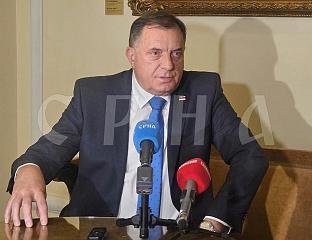
DODIK: REPUBLIKA SRPSKA RECOGNIZED BY U.S. ADMINISTRATION AND RUSSIAN OFFICIALS
MOSCOW, JUNE 5 /SRNA/ – SNSD President Milorad Dodik stated that his primary concern is for Republika Srpska to be noticed and recognized, rather than...
8 hours ago
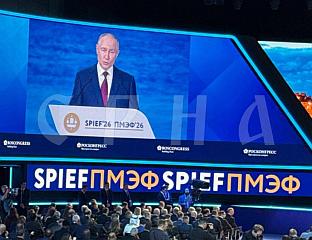
PUTIN: RUSSIA REMAINS OPEN TO PARTNERSHIP WITH ALL WILLING PARTNERS
ST. PETERSBURG, JUNE 5 /SRNA/ - Russian President Vladimir Putin has said today that Russia is open to cooperation with all those interested in workin...
9 hours ago
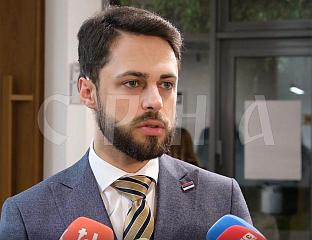
ROMIĆ: AMERICA INCREASINGLY ACKNOWLEDGING OHR NO LONGER SERVES ITS ORIGINAL PURPOSE OFFERS HOPE
BANJA LUKA, JUNE 5 /SRNA/ - Marko Romić, Secretary General to the President of Republika Srpska, has said it is encouraging that the United States is...